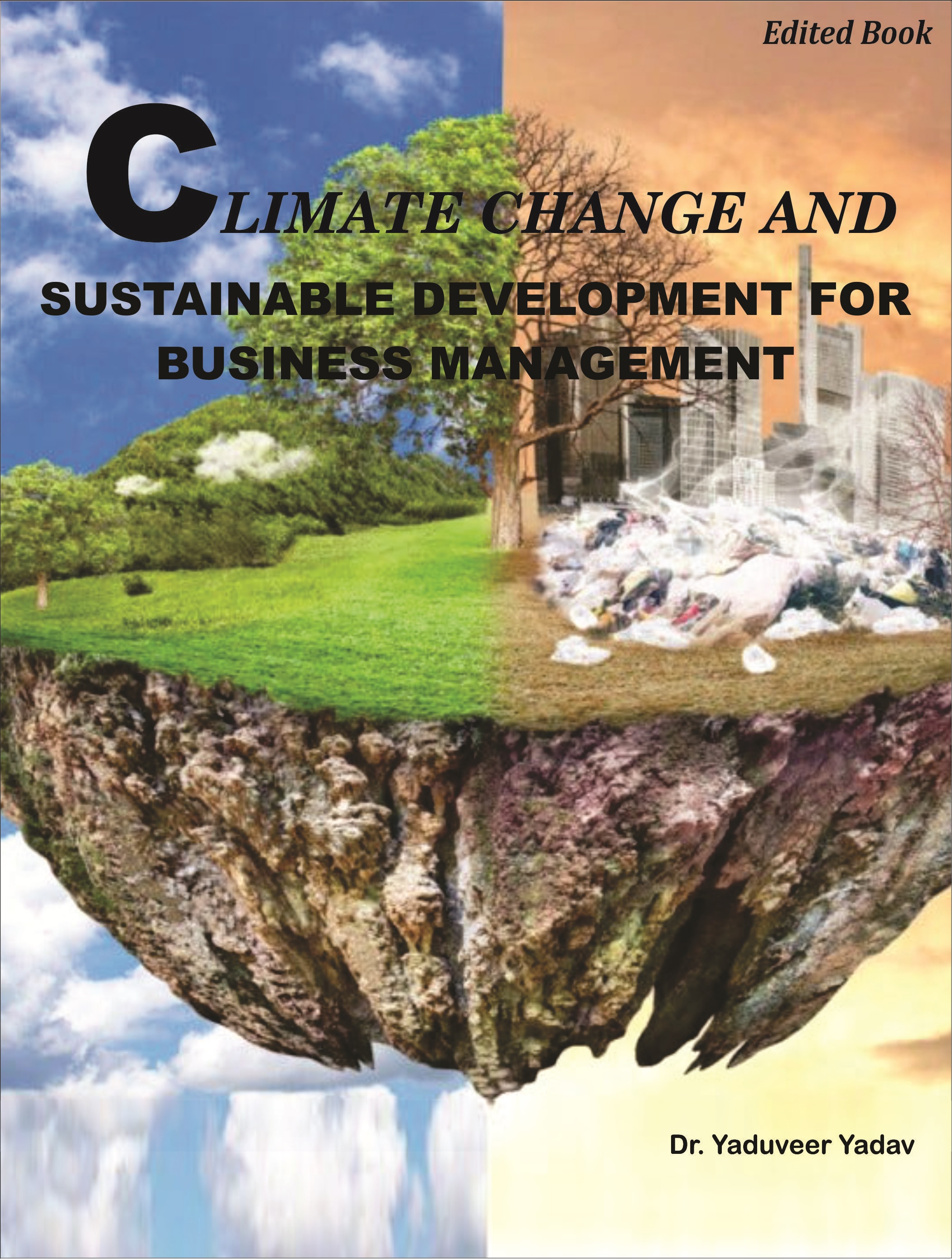
The intersection of climate change and business management is no longer a peripheral concern it has become a central strategic imperative for organisations worldwide. As we stand in the mid-2020s, the scientific consensus is unequivocal: rising global temperatures, extreme weather events, biodiversity loss, and resource scarcity are not distant threats but present realities. For businesses, these changes bring both profound risks and transformative opportunities. This edited volume, Climate Change and Sustainable Development for Business Management, emerges from the urgent need to bridge the gap between environmental consciousness and practical, scalable business strategies. The motivation for this book stems from a simple yet powerful observation: while climate science has advanced significantly, the translation of these insights into actionable business frameworks remains fragmented. Traditional management education has often treated sustainability as an elective or a compliance function, rather than as a core driver of innovation, resilience, and long-term value creation. This book challenges that outdated paradigm. It argues that sustainable development is not a constraint on profitability but a source of competitive advantage enabling organisations to reduce costs, anticipate regulatory shifts, build brand loyalty, attract talent, and future-proof their operations.
In recent years, we have witnessed a decisive shift in the global policy and economic landscape. The post-2030 Agenda for Sustainable Development continues to shape national priorities, while international frameworks such as the Paris Agreement (and its successive strengthened pledges) and the emerging Global Stocktake mechanisms demand greater corporate accountability. Concurrently, investors, consumers, and employees are increasingly holding businesses responsible for their carbon footprints, supply chain ethics, and circular economy practices. Environmental, Social, and Governance (ESG) criteria have moved from voluntary reporting to mandatory disclosure regimes in multiple jurisdictions. Against this backdrop, the role of business managers has expanded from profit maximisation to stakeholder value optimisation within planetary boundaries. This edited book brings together a diverse range of contributions from scholars, researchers, and practitioners, offering both theoretical insights and empirical evidence. The chapters explore critical sub-themes, including sustainable business models, corporate social responsibility (CSR) as environmental stewardship, green innovation, regulatory and policy frameworks, sustainable supply chain management, the financial implications of climate risk, and real-world case studies of successful sustainable practices. Special attention is given to the Indian organisational context, recognising that emerging economies face unique challenges balancing developmental aspirations with ecological limits, navigating informal sectors, and leveraging frugal innovation for low-carbon growth. Each chapter in this volume has been peer-reviewed and follows a rigorous academic standard. We have encouraged authors to adopt interdisciplinary perspectives, drawing from economics, operations, finance, marketing, organisational behaviour, and public policy. The result is a compendium that is both scholarly and accessible—useful for postgraduate students, research scholars, faculty members, corporate executives, and policymakers alike. We extend our sincere gratitude to all contributors who have shared their knowledge and insights. Their willingness to engage with complex, real-world problems has made this book possible. We also thank the editorial and production team for their dedication in bringing this volume to publication in both e-book and physical formats.
As you turn the pages of this book, we invite you to reflect not only on what businesses must do to adapt to a changing climate, but also on how they can proactively shape a more sustainable, equitable, and prosperous future. The transition to a low-carbon economy is already underway. The question is no longer whether businesses should act, but how fast and how boldly. Let this collection serve as both a resource and a catalyst—for critical thinking, for informed decision-making, and for meaningful action.
|
Sr. no. |
Title |
Page no. |
|
1. |
Strategic Synergies Between Climate Change Mitigation and Sustainable Development: A Business Management Framework for the Post-2026 Global Economy Dr. Yaduveer Yadav |
1-8 |
|
2. |
Strategic Green Human Resource Management for Climate Resilience: A Framework for Indian Organisations Dr. Bhawana Sharma |
9-17 |
|
3. |
Building Resilient Healthcare for a Changing Climate: An Indian Management Perspective Dr. Deepti Sharma |
18-25 |
|
4. |
Green Travel Applications and Climate Action: Examining the Role of AI-Powered Digital Platforms in Promoting Sustainable Tourism Behaviour Devvandya Mishra Ms. Cherry Patni Dr. Lokesh Vijayvargy |
26-34 |
|
5. |
Regulatory Frameworks for Sustainable Business: Global Standards, Indian Policies and ESG Governance Dr. Neha Agarwal |
35-52 |
|
6. |
Digital Lending, Climate Vulnerability, and Sustainable Finance in India: An Analytical Study of Risk, Access and Performance Dr. Gaurav Bagra |
53-62 |
|
7. |
Climate Change, Sustainable Development and Corporate Social Responsibility in India: A Theoretical and Review-Based Perspective Dr. Mayank Agarwal |
63-72 |
|
8. |
Green Business Strategies and Sustainable Development in India: A Management Perspective on Climate Action Dr. Rishabh Sharma |
73-83 |
|
9. |
Behavioural Biases and Algorithmic Trading: Impact on Retail Investor Performance in the Indian Stock Market – A Climate Change and Sustainable Development Perspective Dr. Sandeep Aggarwal |
84-93 |
|
10. |
Social Media Platforms As Business Development Tools: An Analytical Study Dr Kirti Agarwal
|
94-102 |
|
11. |
Training and Development as Drivers of Business Growth & Strategic Innovations: An Analytical Study Dr Vikrant Kumar |
103-108 |
|
12. |
Investment Decision Strategy Making and Organizational Expansion – A Study Dr. S.M.Anas Iqbal |
109-114 |
|
13. |
Scenario Planning and Strategic Flexibility in Uncertain Business Environments: An Empirical Study of Indonesian Companies Dr Kirti Agarwal Dr. S.M.Anas Iqbal |
115-121 |
|
14. |
Adoption of Artificial Intelligence in Business Development: Opportunities and Challenges Vishesh Kanti Jain |
122-127 |
|
15. |
Role of Logistics Optimization in Enhancing Business Competitiveness Ms. Paridhi Grover |
128-134 |
|
16. |
Analyzing the Factors Affecting Business Development on Women Entrepreneurship: An Analytical Study Dr. A.K. Singh Dr Vikrant Kumar Dr Kirti Agarwal |
135-141 |
|
|
Epilogue |
142 |
Dr. Yaduveer Yadav
Dr. Yaduveer Yadav is a young, prolific author and academic professional with expertise in Finance, Economics, Banking, and Business Management. He is currently pursuing a D.Litt. in the Department of Business Administration at the University of Rajasthan, Jaipur. He holds a Post Doctoral Fellowship (PDF) from RUSA and ICSSR, a Ph.D. from the University of Rajasthan, and an MBA from Amity University, along with multiple certifications in Banking, Finance, and Quality Control. With extensive experience teaching UG and PG classes across various management institutes, delivering corporate training and counseling sessions, and guiding the implementation of Quality Control Tools in numerous organizations, he seamlessly blends academic depth with corporate insight. He has authored several management books, newspaper articles, and over 50 research papers published in leading national and international journals. He also serves as an editor and editorial board member for multiple journals of international repute. Constantly adding value to students and professionals alike, he stands as an expert in every sense of the word.


